
Tensions and challenges of nation-building
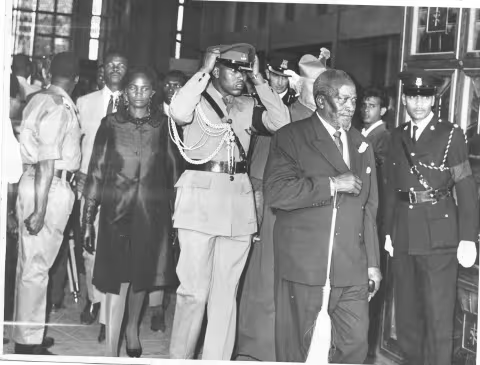
The years following independence were marked by great optimism as Kenya embarked on the task of building a new nation. Yet beneath the spirit of unity and development, significant political differences were emerging among the country's leading figures.
One of the most important political relationships of the independence era was that between President Jomo Kenyatta and Vice President Oginga Odinga.
During the struggle for self-government, the two had worked together harmoniously. However, as the country began defining its political and economic direction, differences emerged over policy, governance and the pace of social and economic change.
The disagreements reflected broader debates taking place across Africa during the Cold War era. Newly independent States were grappling with questions about development, political organisation and relations with competing global powers.
As tensions increased, divisions within the ruling party became more pronounced.
In 1966, Oginga Odinga resigned as Vice President and left the ruling party to form a new opposition movement. The split represented one of the first major political challenges facing independent Kenya and signalled the emergence of competing visions for the country's future.
The political climate was becoming increasingly polarised.
Public debates over inequality, governance and the concentration of political power intensified during the late 1960s and early 1970s. While the government emphasised stability, national unity and economic development, critics called for greater political openness and more equitable distribution of national resources.
The period was also marked by the loss of prominent national leaders.
On July 5, 1969, Thomas Joseph Odhiambo Mboya commonly known as Tom Mboya was assassinated in Nairobi. He was a prominent trade unionist, Pan-Africanist, and Minister for Economic Planning and Development.
One of the country's most influential politicians and an internationally respected statesman, Mboya had played a significant role in the independence movement and the early years of nation-building. His death shocked the nation and generated widespread public grief.
The assassination intensified political tensions and raised questions that would remain part of Kenya's historical discourse for decades.
Several years later, another tragedy further unsettled the country. On March 2, 1975, the badly mutilated decomposing body of Josiah Mwangi Kariuki, popularly known as J.M. Kariuki, was discovered in Ngong Forest by a Maasai herder after he had disappeared under mysterious circumstances. At the time of his death, the former Mau Mau freedom fighter, socialist and Kenyatta’s private secretary (1963-1969), J.M. was the Member of Parliament for Nyandarua North constituency.
J.M. had become a popular and outspoken Member of Parliament known for calling out corruption, inequality and the growing concentration of wealth among leaders. He’s famously remembered for his remarks that “Kenya had become a country of 10 millionaires and 10 million beggars”. His death sparked national outrage and led to widespread public demands for accountability.
A Parliamentary Select Committee chaired by Elijah Wasike Mwangale was set up to investigate his death, and the event became one of the most significant political crises of the Kenyatta era.
The developments highlighted some of the challenges facing the young republic.
As Kenya pursued development and stability, questions about political participation, accountability, equity and governance continued to shape national debate.
By the late 1970s, Kenya had achieved important progress in areas such as education, infrastructure and economic growth. Yet the political tensions of the period revealed that nation-building was a complex process requiring constant negotiation between unity, stability and democratic expression.
As President Kenyatta's health began to decline in the final years of his administration, attention increasingly turned to the future of the country's leadership.
A new chapter in Kenya's history was approaching.