Choosing Kenya's Path to Development
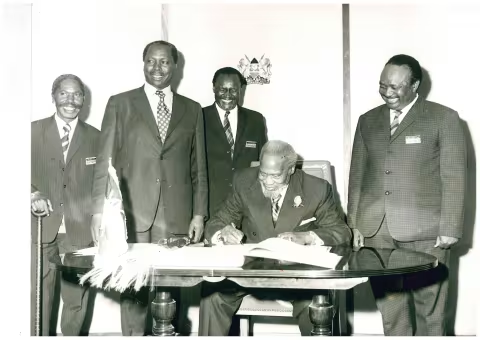
Independence brought freedom, hope and a sense of national purpose. But for Kenya's new leaders, political independence was only the beginning.
The young nation faced enormous challenges. Poverty was widespread, economic opportunities were unevenly distributed and many communities lacked access to essential services such as education, healthcare and infrastructure.
The question confronting the new government was simple but profound: How to transform political freedom into economic progress.
In 1965, President Jomo Kenyatta introduced a landmark policy document known as Sessional Paper No. 10 on African Socialism and Its Application to Planning in Kenya.
More than a government report, the document became a blueprint for Kenya's development strategy during the early years of independence.
At a time when many newly independent African countries were choosing between competing economic systems, Kenya sought to chart its own course.
The policy embraced a philosophy described as African Socialism. Unlike the state-controlled models adopted in some countries, Kenya's approach emphasised a mixed economy that combined government involvement with private enterprise and individual initiative.
The document argued that development should focus on increasing national wealth while expanding opportunities for citizens through education, agriculture, commerce and industry.
One of its most influential principles was the idea that limited national resources should first be invested in areas with the greatest potential for economic growth. Policymakers believed that concentrating investments in productive regions would generate wealth that could later support development across the country.
Supporters viewed the strategy as a practical approach to accelerating economic growth in a young nation with limited resources.
However, critics later argued that concentrating investment in already productive areas risked widening regional inequalities and leaving parts of the country marginalised.
Despite the debates, the impact of Sessional Paper No. 10 was far-reaching. The policy shaped government planning, influenced investment decisions and guided development efforts throughout much of the post-independence period. Its ideas helped define Kenya's economic direction during the formative years of nation-building.
The document also reflected the ambitions of a newly independent country seeking to balance growth, stability and opportunity while forging its own path in a rapidly changing world.
As Kenya pursued development, another powerful idea was beginning to take root across the nation – one that encouraged citizens themselves to participate in building schools, health facilities, roads and community projects.
It was called the spirit of Harambee (Swahili for ‘let us pull together’).