Peace, Love, Unity - a National Doctrine
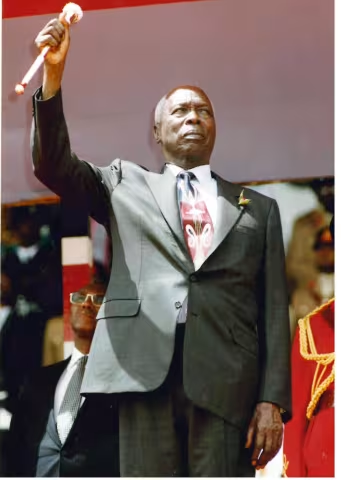
President Daniel arap Moi soon introduced the guiding philosophy of his administration, Nyayoism, rooted in the idea of building on the foundation laid by Jomo Kenyatta while reinforcing national cohesion and stability.
Nyayoism was summarised in ‘Peace, Love and Unity’ as core principles. The principles were presented as the foundation for national development and social harmony in a young and diverse nation still shaping its identity.
The emphasis on Peace reflected the need to maintain stability in a period marked by political sensitivities and regional differences, Love was framed as a call for mutual respect among citizens and communities while Unity underscored the importance of national cohesion above ethnic or regional divisions.
The philosophy was promoted through public messaging, civic education and State institutions, becoming a defining feature of early Moi-era governance.
Supporters viewed Nyayoism as a unifying doctrine that helped maintain stability in a complex political environment. Over time, however, the implementation of the philosophy also became the subject of public debate, particularly regarding the balance between unity and political expression.
Nevertheless, Nyayoism remained one of the most recognisable ideological frameworks in Kenya’s post-independence history. It shaped governance, political discourse and national identity for much of the 1980s and 1990s.
As the Nyayo era took root, Kenya would soon face one of its most dramatic early tests of stability: An attempted coup that would shake the foundations of the new administration.