Final steps to nationhood
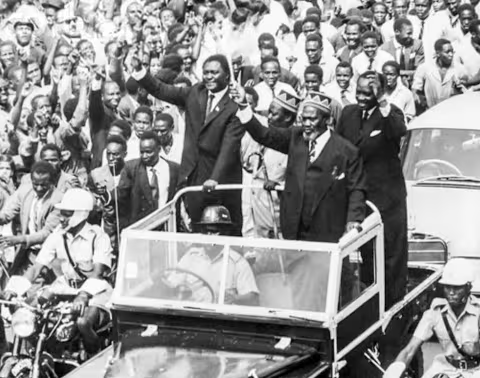
The journey to independence did not happen in a single day.
Kenya's transition from colonial rule to full nationhood unfolded through a series of historic milestones that gradually transferred power from British to Kenyan leadership. Together, the events marked the culmination of decades of political struggle, negotiation and sacrifice.
The first major breakthrough came on June 1, 1963. On this day, Kenya attained internal self-government, a milestone now commemorated every June 1 as Madaraka Day. The word Madaraka means ‘authority’ or ‘self-governance’, reflecting the transfer of responsibility for Kenya's internal affairs from the colonial administration to elected Kenyan leaders.
For the first time, Kenyans gained control over the day-to-day running of their government.
However, Kenya had not yet achieved full independence. The country remained a British territory, and Queen Elizabeth II still the Head of State. Under the new arrangement, Jomo Kenyatta was sworn in as the Prime Minister to head a government responsible for managing Kenya's internal affairs while certain constitutional links with Britain remained in place.
Madaraka, therefore, marked an important turning point: Kenyans began governing themselves.
Yet the struggle for complete sovereignty was not over.
Six months later, on December 12, 1963, Kenya achieved full independence from Britain. On that day, colonial rule formally came to an end. Kenya became a sovereign nation recognised by the international community. The British flag was lowered, the Kenyan flag was raised as celebrations erupted across the country. A nation’s generational dream was achieved.
Kenya was free from colonial rule but, even then, one final constitutional step remained. Although independent, Kenya initially remained a constitutional monarchy within the Commonwealth, with Queen Elizabeth II continuing as Head of State, represented in Kenya by a Governor-General.
Exactly a year later, Kenya adopted a republican constitution. The office of Governor-General was abolished, the British monarch ceased to be Kenya's Head of State and Jomo Kenyatta became the country's first President.
This final transition completed Kenya's journey to full nationhood. The date became known as Jamhuri Day, derived from the Kiswahili word for ‘republic’.
Together, the three milestones tell the story of Kenya's transition to self-rule: Madaraka Day (June 1, 1963) when Kenya gained internal self-government and Kenyans began managing their own affairs; Independence Day (December 12, 1963) when Kenya became a fully sovereign nation, ending decades of colonial rule; and Jamhuri Day (December 12, 1964) hen Kenya became a republic with its own President as Head of State.
Each milestone represented a different step on the road to nationhood.
The struggle for freedom had created an independent country. The challenge ahead was to build a united nation capable of fulfilling the hopes and aspirations that with uhuru.
The new responsibility for post-independence Kenya and Kenyans was now to shape the future of a young republic.